
The Sandler Selling System inverts the usual sales dynamic. Instead of chasing prospects and trying to convince them to buy, the salesperson qualifies (or disqualifies) them, with the prospect doing most of the talking. It was created by David Sandler in 1967 and is still one of the most widely taught methodologies in B2B sales. This is a plain-English walk through how it works: the submarine, the seven steps, the signature techniques, and why it feels so different from conventional selling.
The submarine: seven sealed steps
Sandler's central image is a World War II submarine. A sub survives a hull breach because it is divided into watertight compartments, sealed one at a time, so a leak in one section cannot sink the whole vessel. A Sandler salesperson works the same way: you "seal" each step before moving forward, so the deal cannot quietly leak back into stalling, comparison shopping, or "let me think about it."
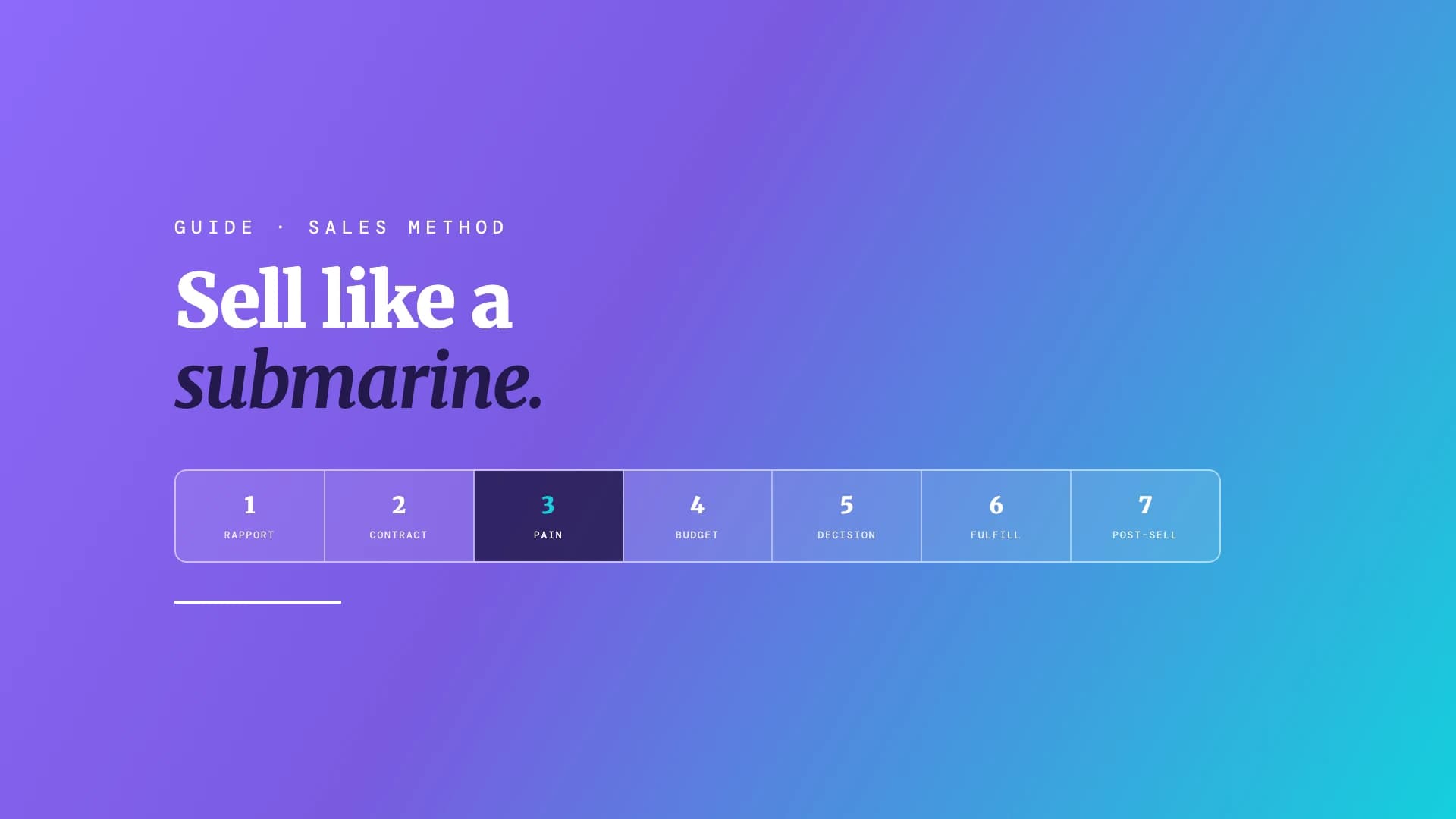
There are seven compartments, grouped into three phases.
- 1Bonding & Rapport. Establish genuine trust and meet the prospect as an equal.
- 2Up-Front Contracts. Agree the purpose, agenda, and outcome of each interaction.
- 3Pain. Uncover the real problem, both emotional and business.
- 4Budget. Find out what they are willing and able to invest.
- 5Decision. Learn how, when, and by whom the decision gets made.
- 6Fulfillment. Present your solution, mapped to their pain, budget, and process.
- 7Post-Sell. Lock in the commitment and head off buyer remorse.
A nuance worth stating: in a real conversation you do not march through these in rigid order, because conversations wander. What matters is that all seven are sealed before the deal closes.
The three phases, in practice
In the relationship phase, the goal is trust and structure. Bonding and rapport is not small talk for its own sake; it earns the right to ask direct questions later. The up-front contract is the quiet superpower here: agreeing at the start what the meeting is for and how it will end ("by the end of this call we will both decide whether it makes sense to continue") prevents the ambiguous, energy-draining "I'll get back to you."
In the qualifying phase, you are deciding whether this is a real deal. Pain comes first, because, as Sandler puts it, if there is no pain, there will be no change. Then budget, because pain without budget is not a sale. Then the decision process, so you are not surprised by a hidden approver at the end. Crucially, a Sandler rep is willing to walk away here if the pain, budget, or decision clarity is not there.
Only in the closing phase do you present. By the time you reach fulfillment, you already know exactly what the prospect needs, can afford, and how they will decide, so the "pitch" is short and tailored rather than a hopeful feature dump. Post-sell then secures the commitment and reduces the risk of the buyer backing out.
The techniques that make it work
A few signature Sandler tactics give the system its character:
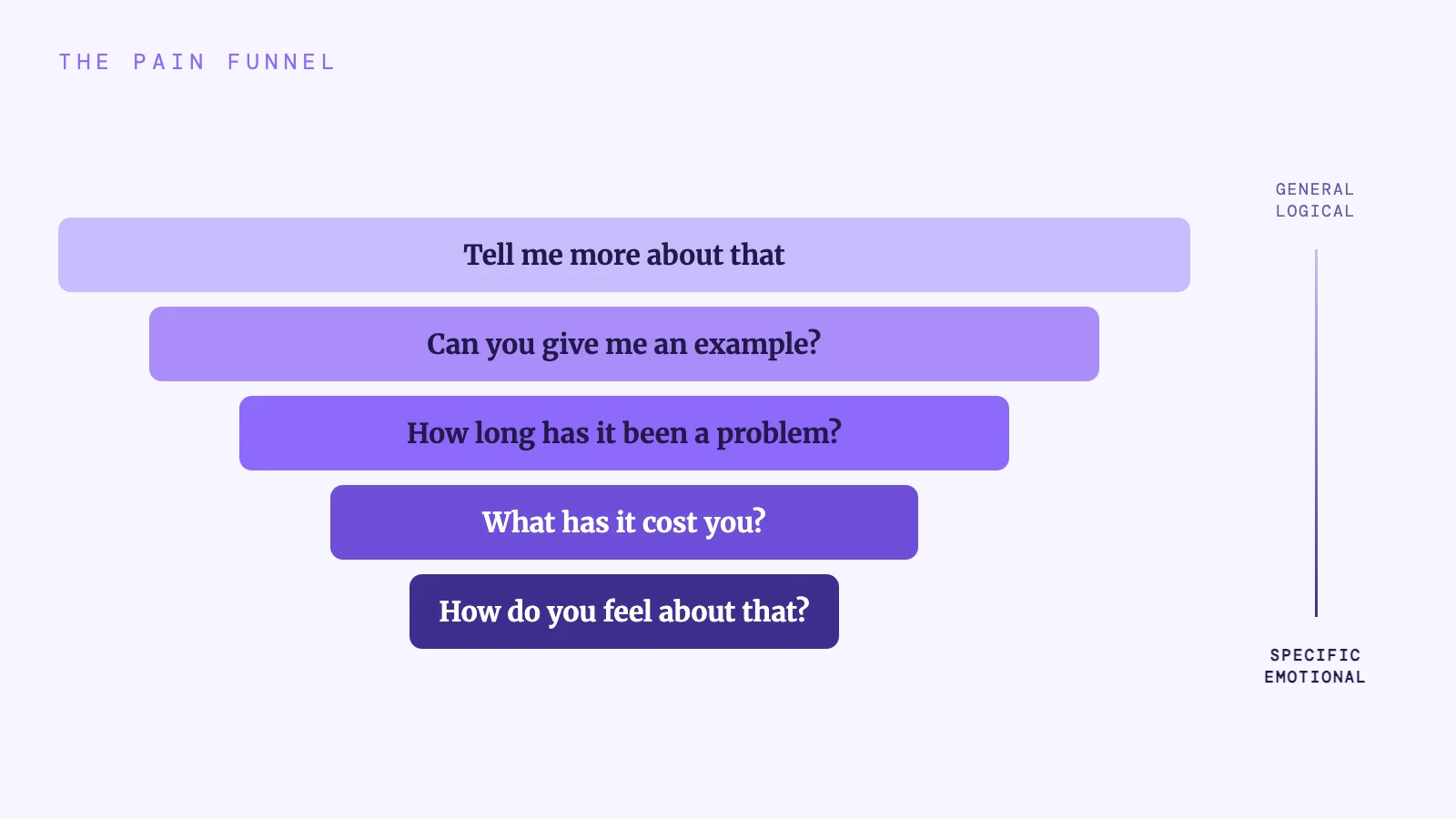
The pain funnel is a sequence of open-ended questions that moves from general to specific and from logical to emotional, on the premise that people buy emotionally and justify logically. It works like peeling an onion, each question revealing a deeper layer. The exact wording varies by trainer, but the arc is consistent: start with "tell me more about that," get specific ("can you give me an example?"), establish duration and prior attempts ("how long has this been a problem? what have you tried?"), quantify the cost, and then reach the emotional core ("how do you feel about that? have you given up trying to fix it?").
Up-front contracts, as above, set mutual expectations for every interaction so meetings end in a clear next step.
Reversing means answering a question with a question to surface the real motive behind it. Asked "how much does it cost?" early on, a Sandler rep responds with something like "it depends, can you help me understand what you are trying to solve first?" rather than blurting a number and losing the discovery.
No free consulting is Sandler's rule against giving away your expertise and solutions before a prospect is qualified and committed, which otherwise turns you into an unpaid consultant whose proposals get used to shop competitors.
And throughout, the prospect should be doing most of the talking. The widely cited rule of thumb is roughly 70 percent listening to 30 percent talking; the exact ratio is a guideline, but the principle is the whole point: you guide with questions, you do not pitch.
How Sandler differs from traditional selling
| Traditional selling | Sandler | |
|---|---|---|
| Who qualifies whom | Seller chases and tries to convert | Prospect must qualify for the seller's time |
| The goal | Convince and close | Qualify honestly, or disqualify early |
| Who talks | Seller pitches features | Prospect talks; rep asks questions |
| Handling questions | Answer, then pitch | Reverse: answer with a question, stay in discovery |
| Sharing the solution | Free advice up front | No free consulting until qualified |
| Unqualified deals | Keep chasing | Walk away; no pressure tactics |
The throughline is stature: Sandler treats buyer and seller as equals, which is what lets the rep ask hard questions, push back, and disqualify without desperation.
Where it fits, and where to be careful
Sandler shines in considered B2B sales with real discovery, multiple stakeholders, and meaningful deal sizes, the situations where qualifying out a bad fit early saves everyone weeks. It is less suited to simple, transactional, low-consideration purchases where the elaborate qualification is overkill. And like any framework, it fails when applied as a rigid script rather than a way of thinking; the techniques are a means to genuine understanding, not a set of tricks.
Make Sandler stick after the call
Sandler lives or dies on what you learn in the conversation: the prospect's pain, their budget, their decision process. The discipline problem is that those details are easy to capture badly while you are also trying to listen at 70 percent. This is where recording your sales calls (with consent) and letting a tool like Neural Summary pull out the structured notes pays off: you get the pain points, the next steps, and a CRM-ready summary without breaking eye contact to type. The methodology gives you the right questions; capturing the answers cleanly is what lets you actually act on them. Just remember to tell the prospect you are recording, see our recording-law guide for how consent works.
The bottom line
The Sandler Selling System replaces convincing with qualifying. Seal each of the seven steps, bonding, up-front contracts, pain, budget, decision, fulfillment, and post-sell, before moving on. Use the pain funnel to let prospects talk themselves into recognizing their own problem, reverse questions to stay in discovery, and refuse to give free consulting to unqualified buyers. Done well, you close fewer bad deals and waste far less time, which is the entire point.
Frequently asked questions
What are the 7 steps of the Sandler Selling System?
In order: Bonding & Rapport, Up-Front Contracts, Pain, Budget, Decision, Fulfillment, and Post-Sell. They group into three phases: building the relationship (steps 1 to 2), qualifying the prospect (steps 3 to 5), and closing the sale (steps 6 to 7).
What is the Sandler submarine?
It is the metaphor at the heart of the method. Like a submarine's watertight compartments, each step is "sealed" before you advance, so the deal cannot leak backward into stalling or comparison shopping. All seven compartments must be sealed before the sale closes.
What is the Sandler pain funnel?
A sequence of open-ended questions that moves from general to specific and from logical to emotional, helping the prospect uncover the true depth and cost of their problem. The rep mostly asks and listens; the prospect does the realizing.
How is Sandler different from traditional sales?
Traditional selling chases prospects and tries to convince them; Sandler qualifies them, with the rep treating the buyer as an equal, asking questions instead of pitching, refusing to give free consulting, and being willing to walk away from a bad fit. The prospect does most of the talking.
Is the Sandler method still relevant?
Yes, especially for considered B2B sales with real discovery and multiple stakeholders. It is less necessary for simple transactional purchases, and it works best as a way of thinking rather than a rigid script.