
Most meeting minutes fail in the same way: they record everything that was said and almost nothing that needs to happen. A week later, nobody rereads them, and the decisions they captured quietly evaporate. Good minutes are the opposite. They are short, they lead with what was decided, and every action has an owner and a date. This guide covers what to capture, a template you can reuse, and the fastest way to produce minutes: stop typing and let the meeting write its own.
What meeting minutes are, and what they are not
Minutes are the official short record of a meeting: the decisions made, the actions agreed, and just enough context to make sense of them later. They are not a transcript (the full word-for-word text), and they are not a recap email (a friendlier summary you send round). The minutes are the source of truth; a recap is how you distribute it.
The distinction matters because the most common mistake is writing minutes that read like a transcript: a chronological wall of who-said-what. That captures the conversation but buries the outcome. Minutes should be skimmable in thirty seconds and answer one question: what now?
What to capture
Strong minutes are mostly the same four things, every time:
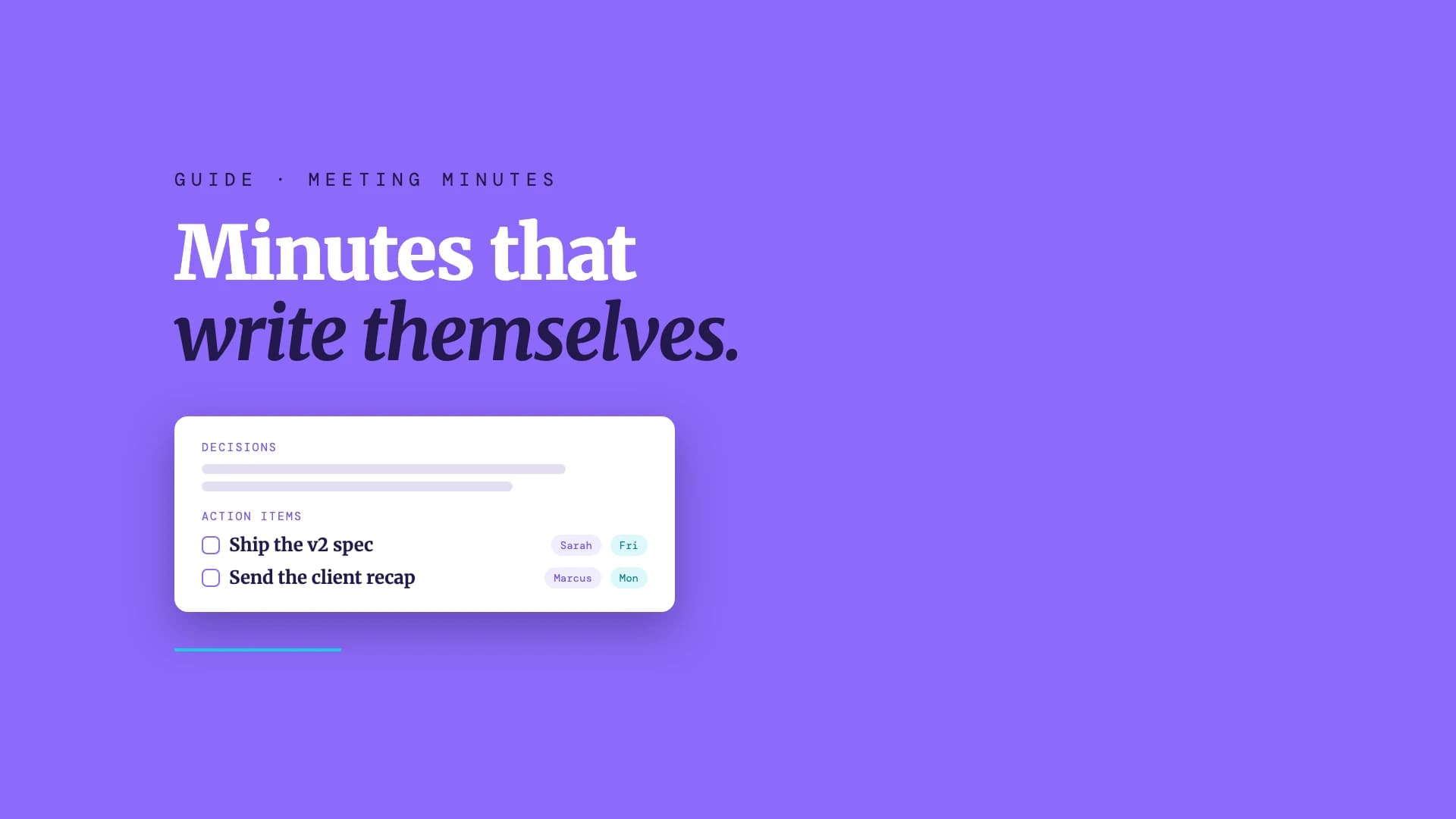
The decisions, stated plainly. Not "we discussed pricing" but "we decided to hold the price increase until Q3." The action items, each with a single owner and a due date. "Marketing will look into it" is where accountability dies; "Marcus sends the recap by Monday" is where it lives. The key context behind a decision, in a line, so a reader who missed the meeting understands the why. And anything carried forward: open questions and the date of the next meeting.
Everything else, the back-and-forth, the tangents, the half-ideas, belongs in the transcript if you kept one, not the minutes.
A simple meeting minutes template
You do not need anything fancy. This structure works for almost any meeting:
- >Meeting: name, date, attendees
- >Decisions: the calls that were made, one line each
- >Action items: task, owner, due date
- >Notes: key context or open questions worth keeping
- >Next meeting: date and anything to prepare
Keep the order: decisions and actions first, because that is what people came for. Detail last, because that is what they will skip.
The fast way: let the meeting write its own minutes
Here is the shift that makes minutes effortless instead of a chore. Taking good minutes live is genuinely hard, because you cannot both fully participate and accurately capture every decision and owner. So do not. Record the meeting (with everyone's knowledge), and let an AI tool turn the recording into structured minutes: the decisions, the action items with owners, and a recap you can send. You stay in the conversation; the minutes are waiting when it ends.
That is the same record you would have hand-written, minus the hour of writing it, and with nothing missed because you were busy talking. If you want the longer argument for why the write-up, not the meeting, is the real bottleneck, see meeting summaries are not deliverables.
Common mistakes
A few habits quietly ruin otherwise fine minutes. Writing them as a transcript, so the outcome is buried. Leaving action items without an owner or a date, so nothing gets done. Waiting a day to write them up, by which point the detail has faded. And never reviewing them, so last meeting's commitments never get checked. The fix for all four is the same: capture decisions and owners in the moment (or let a tool do it), and open the next meeting by reviewing the open actions.
From minutes to momentum
The point of minutes is not the document. It is that the meeting leads somewhere. That is what Neural Summary is built to do: record or upload the meeting, and get back clean minutes, the decisions, and action items with suggested owners, ready to share before everyone has left the room. The work that used to happen after the meeting now happens during it.
The bottom line
Good meeting minutes are short, lead with decisions, and give every action an owner and a date. Use a simple template, put outcomes first and detail last, and stop trying to capture everything by hand. Record the meeting and let AI produce the minutes, so you can be present in the conversation and still walk away with a record people actually act on.
Frequently asked questions
What should be included in meeting minutes?
The decisions made, the action items (each with an owner and a due date), brief context behind the decisions, and anything carried forward such as open questions and the next meeting date. Plus the basics: meeting name, date, and attendees. Leave the play-by-play to the transcript.
What is the difference between minutes and a transcript?
A transcript is the full word-for-word record of everything said. Minutes are the short, curated record of what was decided and what happens next. The transcript is raw material; the minutes are the outcome.
How do you write meeting minutes quickly?
The fastest way is not to write them live at all. Record the meeting and use an AI notes tool to generate the decisions and action items automatically, then edit. If you are taking them by hand, use a fixed template and capture only decisions, owners, and dates in the moment.
Who should take the meeting minutes?
Traditionally a designated note-taker, but that person then cannot fully participate. A better split is to let a recording or AI tool capture the record while everyone, including the would-be note-taker, takes part in the discussion.
How detailed should meeting minutes be?
Detailed enough to be unambiguous about decisions and owners, and no more. Aim for something a busy colleague can skim in under a minute. If you need the full detail, keep the transcript and link to it; do not pad the minutes with it.