
If you are part of a conversation, you can legally record it in most of the world. The majority of countries, and most US states, follow a "participant consent" rule, which means a recording is lawful as long as one person in the conversation agrees, and that person can be you. A smaller group of places requires everyone to agree, and a few treat secret recording as a crime. On top of all that sits a second layer, data-protection law, which governs not whether you can press record but what you may do with the recording afterward.
So the honest answer to "is it legal to record a conversation" is: usually yes when you are in it and the recording is for your own use, sometimes no, and the details depend on where everyone is sitting. This guide walks through the US, Europe, and Asia, and ends with the one habit that keeps you safe almost everywhere.
A note from us at Neural Summary: this article is general information, not legal advice. We are not lawyers and we cannot tell you what is lawful in your specific situation. Recording and privacy laws change, carry exceptions, and are interpreted differently by courts. Before you rely on anything here, check the current rules for your country or state and for the locations of everyone involved, or talk to a qualified attorney. For the US, the Reporters Committee for Freedom of the Press keeps a useful state-by-state guide.
Three questions decide whether a recording is fine
Almost every situation comes down to three questions.
First, are you part of the conversation? Recording a conversation you are in is treated very differently from secretly taping other people you are not part of. The second is illegal almost everywhere; it is the classic definition of eavesdropping or wiretapping. The first is where most everyday recording lives, and it is far more permissive.
Second, which consent model applies where the people are? Some places need just one participant to agree (that can be you). Others need everyone to agree. This is the difference that trips people up on international calls.
Third, what will you do with the recording? Keeping a recording of your own meeting so you can remember what was decided is the lightest-touch use there is. Publishing it, sharing it, or processing other people's data commercially is where data-protection law (most famously the EU's GDPR) starts to apply.
Hold those three in mind and the country-by-country picture gets much simpler.
Two models of consent
Around the world, consent rules sort into two broad models.
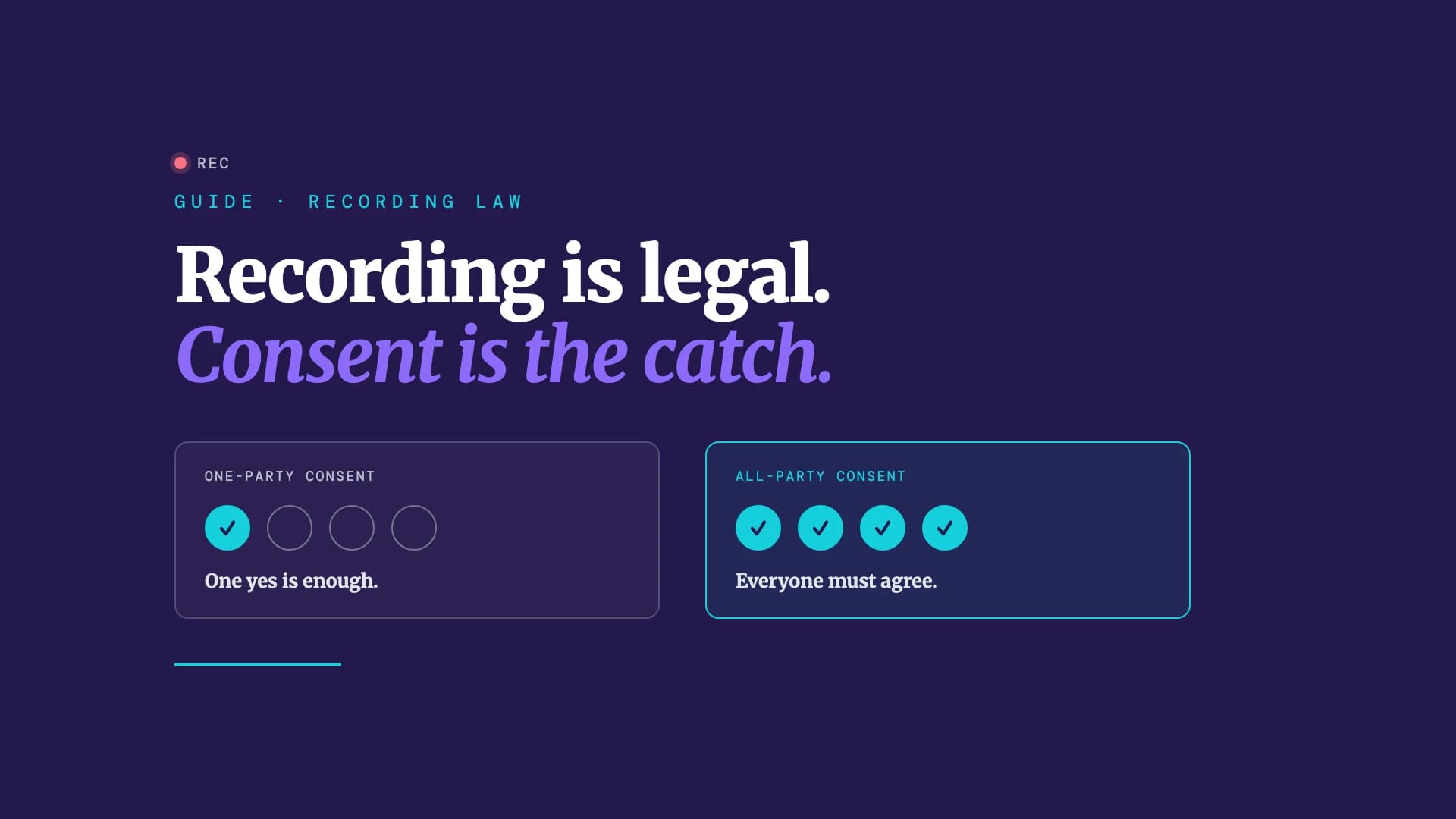
Participant consent (often called one-party consent) means anyone taking part in a conversation may record it, because their own consent is enough. You do not need to ask the others, although telling them is always wiser. This is the majority position globally.
All-party consent (sometimes loosely called two-party consent, though it really means everyone) requires consent from every person in the conversation. Recording without it can be unlawful, and in a few countries it is a criminal offense even when you are a participant.
Most of the world leans toward the participant model. The important exceptions, the places where you genuinely need everyone to agree, are a minority, but they include some large economies, so they are worth knowing.
| Where | Can you record your own conversation? | The catch |
|---|---|---|
| US (federal + most states) | Yes, participant consent | About a dozen states need everyone |
| UK | Yes, for personal use | Sharing or business use triggers data law |
| Germany | No, everyone must consent | Criminal without consent |
| France | No, everyone must consent | Criminal without consent |
| Netherlands, Spain, Italy | Yes, as a participant | Publishing it can still be unlawful |
| Japan, South Korea, Singapore | Yes, as a participant | Data-protection law governs business use |
| India | Gray area | Often admissible, but a privacy risk |
| Australia | Depends on the state | Five of eight require all parties |
The United States
US federal law sets a participant-consent baseline. Under the federal Wiretap Act, a recording is lawful if at least one party to the conversation consents, and because you count as a party to any conversation you take part in, you can record your own calls and meetings. Recording a conversation you are not part of, secretly, is the illegal wiretapping case.
Most states follow that same one-party rule, and a minority require all-party consent. The split is lopsided, so rather than a long list, here is which states fall on each side at a glance:
One-party consent
38 + federalYou can record a conversation you are in. Federal law and most states.
- Alabama
- Alaska
- Arizona
- Arkansas
- Colorado
- Georgia
- Hawaii
- Idaho
- Indiana
- Iowa
- Kansas
- Kentucky
- Louisiana
- Maine
- Michigan
- Minnesota
- Mississippi
- Missouri
- Nebraska
- New Jersey
- New Mexico
- New York
- North Carolina
- North Dakota
- Ohio
- Oklahoma
- Rhode Island
- South Carolina
- South Dakota
- Tennessee
- Texas
- Utah
- Vermont
- Virginia
- West Virginia
- Wisconsin
- Wyoming
- Washington DC
All-party consent
12 statesEveryone in the conversation must agree first.
- California
- Connecticut
- Delaware
- Florida
- Illinois
- Maryland
- Massachusetts
- Montana
- New Hampshire
- Oregon
- Pennsylvania
- Washington
When a call crosses state lines, which is most calls, it is genuinely unsettled whose law applies, and courts have gone both ways. The safe move is to follow the stricter rule, which almost always means getting everyone's agreement.
Europe: consent plus data protection
Europe adds a second dimension. On top of each country's recording rules, the EU's General Data Protection Regulation (GDPR) treats a voice recording of identifiable people as personal data, so once you move beyond purely personal use, you need a lawful basis, transparency, and sensible retention. The picture splits into two parts: is the act of recording allowed, and is the later use compliant.
The general European pattern is that a participant may record their own conversation, with two strict outliers.
The United Kingdom lets a participant record a conversation they are in, even quietly, when it is kept for personal use. The interception law (RIPA) targets people who are not part of a communication, not participants recording their own. Purely personal or household recording also falls outside most UK GDPR obligations. The protections fall away the moment you share, publish, or use the recording commercially, at which point full data-protection duties apply.
Germany is the strict one. Under section 201 of the Criminal Code (the confidentiality of the spoken word), it is a criminal offense to record someone's non-public spoken words without their consent, and that applies to participants, not just eavesdroppers. Penalties run up to three years. A clear spoken notice that recording is starting, where people then choose to continue, is treated in practice as consent, but explicit agreement is the safe path.
France is similarly strict. Article 226-1 of the Criminal Code punishes recording private or confidential words without the speaker's consent, with up to a year in prison and a substantial fine, and authoritative readings apply it to participants too. Consent is presumed when the recording is done openly and the others could have objected but did not.
The Netherlands sits on the permissive side: a participant may lawfully record a conversation they take part in, even without telling the others, because the criminal rule targets non-participants. Spain and Italy land in a similar place through their courts, a participant recording their own conversation is not the criminalized interception of others. In all three, publishing or sharing the recording can still create separate privacy liability.
One concept ties Europe together for ordinary people: GDPR's "purely personal or household activity" exemption. Recording a meeting only to remember it yourself, with no commercial connection and no sharing, can fall outside most of GDPR's obligations. The moment it is for business, the full rules apply: a lawful basis, a privacy notice, purpose limits, retention limits, and security. Courts read the personal exemption narrowly, and it never excuses the company or tool doing the processing, but it is exactly why recording your own meeting for your own recall is the lightest-touch case in Europe.
Asia and Australia
Most of Asia follows the participant model, with data-protection laws increasingly governing the afterlife of the recording rather than the act itself.
Japan effectively treats participant recording as legal, and its courts broadly accept such recordings as evidence. South Korea is similar in effect: its communications-secrets law criminalizes recording a conversation "between others," which by its wording leaves a participant free to record their own, while recording a conversation you are not part of is a serious crime. Singapore has no all-party criminal rule and is, in practice, a participant-consent jurisdiction for individuals, with its data-protection law (the PDPA) aimed at organizations rather than people acting personally. China has no clean ban on recording a conversation you are in, and its courts increasingly admit such recordings as evidence unless they seriously infringe someone's rights, while its personal information law (PIPL) governs what businesses do with the audio afterward.
India is the genuine gray area. Intercepting other people's communications is tightly controlled and criminal, while recording a conversation you are part of is not a wiretapping crime but, since the Supreme Court recognized privacy as a fundamental right, is widely treated as a potential civil privacy wrong. In practice such recordings are often admitted as evidence, which makes the position "frequently usable, but not safely 'legal' to do without care."
Australia is a patchwork. There is no single national rule; each state and territory sets its own, and unlawful recording is a criminal offense. Roughly five of the eight (including New South Wales and Western Australia) require all-party consent for a private conversation, while a few (such as Victoria and Queensland) allow a participant to record. As of mid-2025 a new federal privacy tort can also reach covert recording. If you operate across Australian states, assume the stricter all-party rule.
The safest thing you can do, anywhere
You can collapse almost all of this complexity into one habit: tell people you are recording, and give them a moment to react.
A short, clear announcement at the start of a meeting does three things at once. In participant-consent places it is courteous and removes any doubt. In all-party places it is how you actually get the consent the law requires. And in strict countries like Germany and France, it is the difference between a lawful recording and a criminal one. Where a meeting crosses borders, disclosure satisfies the strictest rule in the room. It costs you one sentence, and it replaces a thicket of jurisdictional questions with a simple yes.
Modern meeting tools make this easy because they show a visible recording indicator. On Zoom, Microsoft Teams, and Google Meet, recording is announced and on-screen by design, which is exactly the kind of openness these laws reward. The thing to avoid is the secret recording: hidden capture is what most of these statutes were written to punish.
Recording your own meetings so you can act on them
Step back from the law for a moment and look at why most people record a meeting at all. It is rarely to catch anyone out. It is to remember. You were present, you took part, and a week later you need to know what you agreed to, what the client asked for, and what you promised to do next. That is the most human reason to record, and it is also, conveniently, the most defensible one almost everywhere: a conversation you are part of, captured for your own recall, used to follow through.
This is the use Neural Summary is built for. You record or upload a meeting you took part in, and instead of a raw file you forget about, you get a clean summary, the decisions, and a list of action items you can actually work from. The point is not surveillance. The point is that the meeting leads somewhere, that the things people agreed to do get done. If you only ever use it to keep your own promises straight, that is a perfectly good reason, and a perfectly safe lane to be in.
Do the responsible thing, which is also the simple thing: say you are recording, keep the recording for a clear purpose, and do not pass other people's private conversations around. Stay in that lane and you can capture your meetings with a clear conscience, in nearly every country covered above.
The bottom line
Recording a conversation you are part of is legal across most of the world under participant-consent rules. A minority of places, including Germany and France, require everyone to agree, and a few treat secret recording as a crime, so international and cross-border calls should default to the stricter standard. A second layer, data-protection law like GDPR, governs what you do with the recording, with a light touch for purely personal recall and full obligations for business use. None of this is hard to comply with, because the safest practice is also the simplest and the most decent: tell people you are recording, and use the recording to actually move the work forward.
Frequently asked questions
Is it illegal to record a conversation without consent?
It depends on where you are and whether you are part of the conversation. In participant-consent places (most US states, the UK, the Netherlands, much of Asia) recording a conversation you are in is legal because your own consent counts. In all-party places (about a dozen US states, plus countries like Germany and France) you need everyone's consent, and in the strictest countries recording without it can be a crime. Secretly recording a conversation you are not part of is illegal almost everywhere.
Can you record someone without their consent?
If you are a participant in a participant-consent jurisdiction, generally yes. In all-party jurisdictions you need their consent too. Because the rules differ by location and calls often cross borders, the reliable practice is to tell everyone you are recording and get a clear yes.
Is it legal to record a conversation without the other person knowing?
In many places it can be, if you are part of the conversation and keep it for personal use. But several countries (notably Germany and France) treat secret recording of private speech as a criminal matter, and even where covert recording is legal, disclosing it is a separate question. The dependable rule everywhere is to disclose that you are recording.
Is it legal to record a conversation in the UK?
Generally yes if you are a participant and the recording is for your own personal use; the interception law targets non-participants. Once you share, publish, or use it for business, UK data-protection law applies, so you need a proper basis, transparency, and sensible retention.
Is it legal to record a meeting in Germany or France?
These are the strict cases. Both treat recording someone's private or non-public spoken words without consent as a criminal offense, and this applies even when you are part of the conversation. The practical answer is to get everyone's agreement first, which a clear recording announcement, accepted by the participants, can provide.
Does GDPR allow recording meetings?
Yes, when done properly. A recording made purely to help you personally remember a meeting, with no commercial connection and no sharing, can fall under GDPR's personal or household exemption. For business use, GDPR applies fully: you need a lawful basis, a privacy notice, purpose and retention limits, and security for the data.
Can I record a work meeting on Zoom or Teams?
Often yes, but check your local consent rule and your employer's policy, which can be stricter than the law. Using the platform's built-in recording, which shows a visible indicator and announces itself, is far safer than recording secretly. The simplest path is to tell attendees the meeting is being recorded.
What happens if you record someone illegally?
Depending on the country, illegal recording can be a criminal offense carrying fines or imprisonment, and it can expose you to civil claims. Illegally obtained recordings are also frequently inadmissible as evidence, so they may not even serve the purpose you intended.