
The Level 10 Meeting is the weekly leadership meeting at the heart of EOS, the Entrepreneurial Operating System popularized by Gino Wickman in his book Traction. The name captures the goal: a meeting so focused and productive that everyone would rate it a 10 out of 10. It is built around a fixed 90-minute agenda where most of the time goes to actually solving problems, not reporting on them. Here is the agenda, what each part does, and the handful of rules that make it work.
The 90-minute agenda
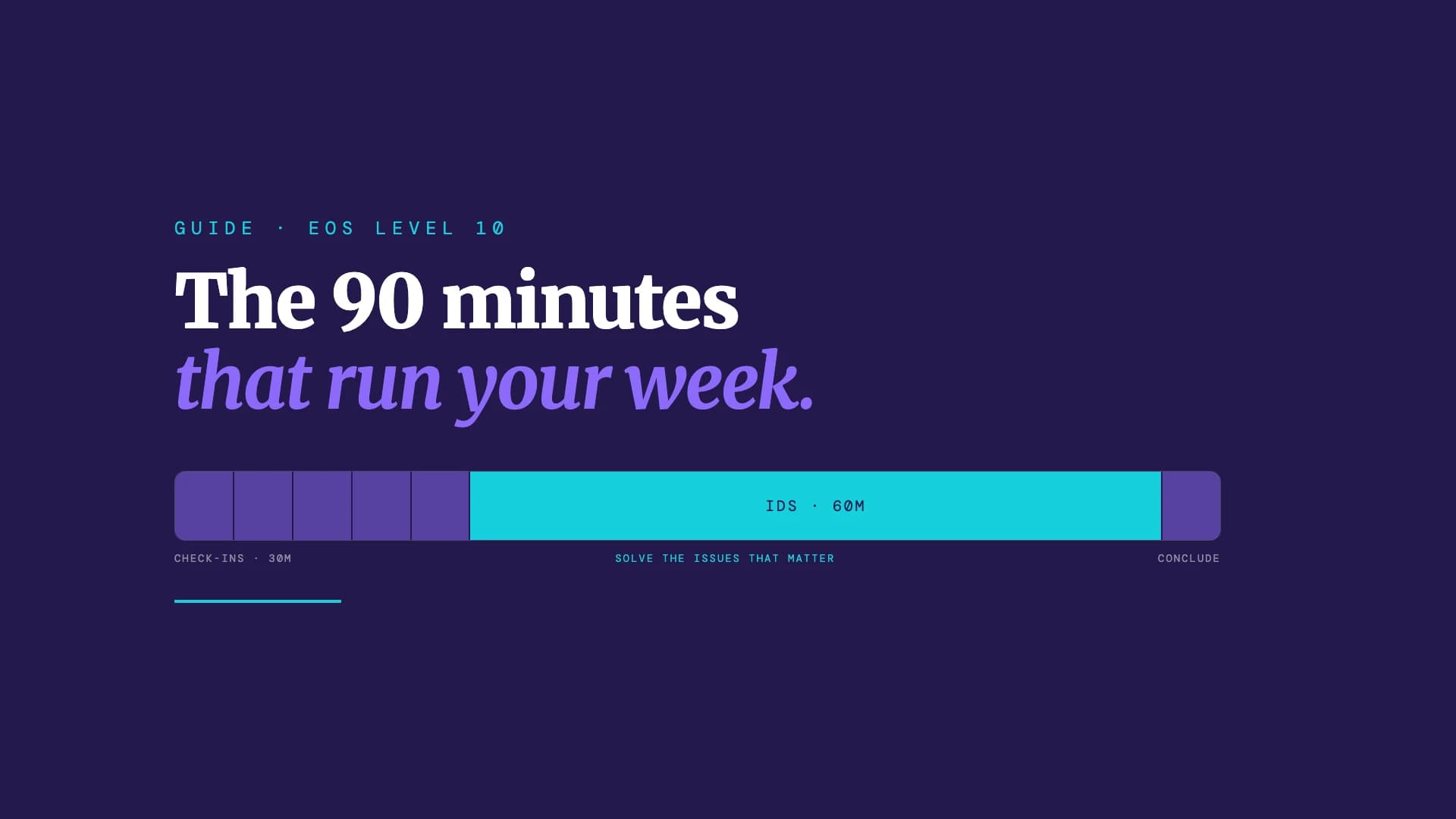
The defining feature of the Level 10 is that the agenda never changes. Same seven segments, same time boxes, every week:
- 1Segue5 min
- 2Scorecard5 min
- 3Rock Review5 min
- 4Customer / Employee Headlines5 min
- 5To-Do List5 min
- 6IDS (Issues)60 min
- 7Conclude5 min
- Total90 min
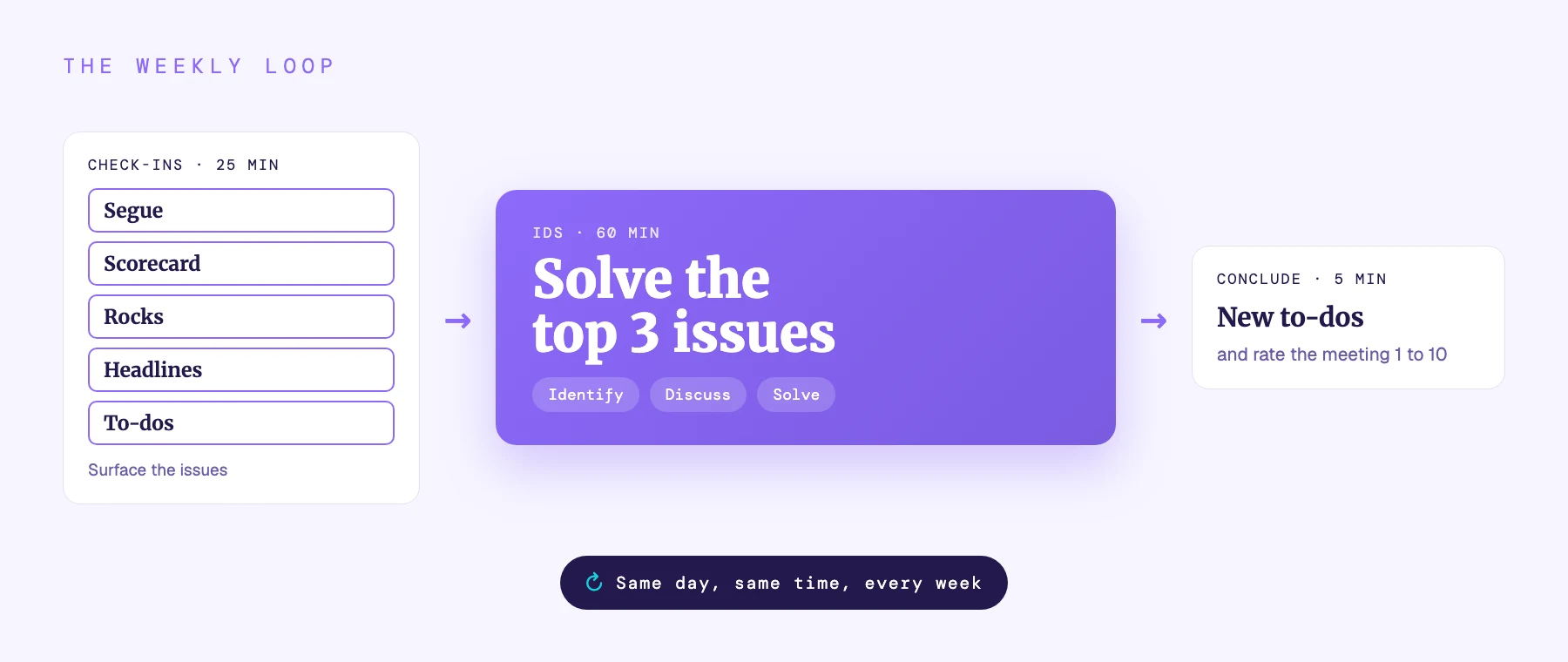
Notice the shape: 25 minutes of fast check-ins, then a full hour to solve issues, then a tight close. That ratio is the whole philosophy. The check-ins exist to surface problems quickly so the hour that follows can be spent fixing them.
What each segment does
The Segue is a quick transition in. Each person shares one piece of good news, personal and professional, which moves the team from working in the business to working on it.
The Scorecard is a five-to-fifteen-number weekly dashboard. You read each measurable and call it simply on-track or off-track. Anything off-track is not discussed here; it drops to the issues list to be solved later.
The Rock Review checks quarterly priorities ("Rocks"), again reported as on-track or off-track only. Off-track Rocks drop to the issues list.
Headlines are quick, factual updates about customers and employees, good or bad. Anything that needs resolution becomes an issue.
The To-Do List reviews last week's seven-day commitments, each marked done or not done. The target is 90 percent or better completion. Anything stuck drops to the issues list.
You will notice the pattern: the first five segments are deliberately fast and binary, and their only job is to move anything that needs real discussion onto the issues list. No problem-solving happens until IDS.
IDS: the heart of the meeting
The 60-minute IDS block is where the Level 10 earns its keep. IDS stands for Identify, Discuss, Solve, and the team does not work through the issues list top to bottom. Instead you pick the three most important issues and solve them in priority order, because solving the few that matter beats touching all of them.
Identify means getting to the real root cause, not the surface symptom. EOS's line is that a well-identified issue is half solved, and that the stated problem is rarely the actual one, so you keep asking why until you hit the root.
Discuss means an open, honest, focused conversation where everyone argues for the good of the whole company, not their own department. The discipline here is to stop discussing the moment the path forward is clear, rather than rehashing.
Solve means turning the issue into a concrete decision with a single owner and a due date, which becomes a to-do on next week's list. The aim is to solve it for good so it never returns to the issues list.
The rules that make it work
A Level 10 is effective because of a few non-negotiable habits, not because of charisma in the room:
- ✓Run it weekly, same day, same time, same agenda. The consistency removes the overhead of scheduling and re-planning, and builds a rhythm the team can rely on.
- ✓Keep the check-in segments fast and binary. On-track or off-track only, so the early segments cannot swallow the hour reserved for solving.
- ✓Send off-track items and stuck to-dos to the issues list. They become issues automatically, rather than triggering a tangent in the wrong segment.
- ✓Recap and rate the meeting in Conclude. Capture new to-dos, decide what to cascade to the wider team, and have each person rate the meeting 1 to 10, aiming for an average of 8 or higher.
That rating ritual is what gives the meeting its name and its self-correcting quality: a team that rates its meetings honestly every week tends to fix the things that drag them down.
Common mistakes
The Level 10 fails in predictable ways. Teams let the early segments turn into discussion, so the Scorecard balloons and IDS gets squeezed. They work the issues list top to bottom instead of prioritizing the top three. They "solve" issues without assigning a single owner and date, so the same issue reappears the following week. And they skip the rating, losing the feedback loop that keeps the meeting honest. If your Level 10 routinely runs over or feels like a status meeting, one of these is usually the culprit.
Run it without losing the issues
The Level 10 generates a lot of structured output in 90 minutes: new to-dos with owners and dates, decisions, and a list of issues solved or carried. Capturing all of that accurately, while also facilitating, is genuinely hard, and a dropped to-do undermines the whole cadence. This is where recording the meeting and letting a tool like Neural Summary produce the to-do list, decisions, and issue outcomes for you helps: the facilitator stays focused on IDS, and the follow-up is ready the moment you conclude. The system gives you the structure; capturing it cleanly is what makes it stick week to week. For more on running meetings that end in action, see our guide on how to run a staff meeting.
The bottom line
The Level 10 Meeting is a fixed 90-minute weekly agenda built so that 25 minutes of fast check-ins feed an hour of real problem-solving. Keep the early segments binary, push everything that needs discussion to the issues list, and spend IDS identifying root causes and solving the top three issues with owners and due dates. Run it the same day and time every week, and rate it honestly at the end. That discipline, more than any single segment, is what makes it work.
Level 10 Meeting and EOS are registered trademarks of EOS Worldwide. This is an independent explainer, not affiliated with or endorsed by EOS Worldwide.
Frequently asked questions
What is a Level 10 Meeting?
It is the weekly 90-minute leadership meeting in EOS (the Entrepreneurial Operating System from the book Traction). It follows a fixed agenda of quick check-ins followed by an hour of structured problem-solving, and is named for the goal of every attendee rating the meeting a 10 out of 10.
What is the Level 10 Meeting agenda?
Seven segments totaling 90 minutes: Segue (5), Scorecard (5), Rock Review (5), Customer/Employee Headlines (5), To-Do List (5), IDS / Issues (60), and Conclude (5). The agenda stays the same every week.
What does IDS mean?
Identify, Discuss, Solve. It is the 60-minute core of the meeting: identify the real root cause of an issue, discuss it openly until the path is clear, and solve it by assigning a single owner and due date. Teams tackle the top three issues by priority, not the whole list in order.
How long is a Level 10 Meeting?
Ninety minutes for a leadership team, held weekly on the same day and time. Departmental versions sometimes run shorter (30 to 60 minutes), but the structure is the same.
Why is it called a Level 10 Meeting?
Because the goal is a meeting good enough that everyone would rate it a perfect 10. At the end, each person rates the meeting from 1 to 10, with a target team average of 8 or higher, which creates a weekly feedback loop for improving the meeting itself.