
Most staff meetings are tolerated, not valued. People show up, half-listen while clearing their inbox, take turns reading status updates aloud, and leave without anything having changed. That is a shame, because a well-run staff meeting is one of the highest-leverage hours a team has. The fix is not a better icebreaker. It is treating the meeting as a place to align and decide, not to report. Here is how.
What a staff meeting is, and what it is not
A staff meeting is the recurring gathering of a manager and their team to align on goals, surface and solve problems, make decisions, and coordinate work. The keyword is alignment: keeping everyone moving in the same direction.
It is easy to ruin a staff meeting by asking it to do a job another format does better:
A one-on-one is for an individual: personal development, feedback, and blockers that affect one person. If a topic only concerns one person, it belongs in a one-on-one, not the team meeting. An all-hands is for the whole company: transparency, strategy, and celebrating wins across the org. A daily standup is a fast, ten-to-fifteen-minute coordination check, deliberately not the place for deep problem-solving. The staff meeting sits in the middle: the team, aligning and solving together.
A staff meeting agenda that works
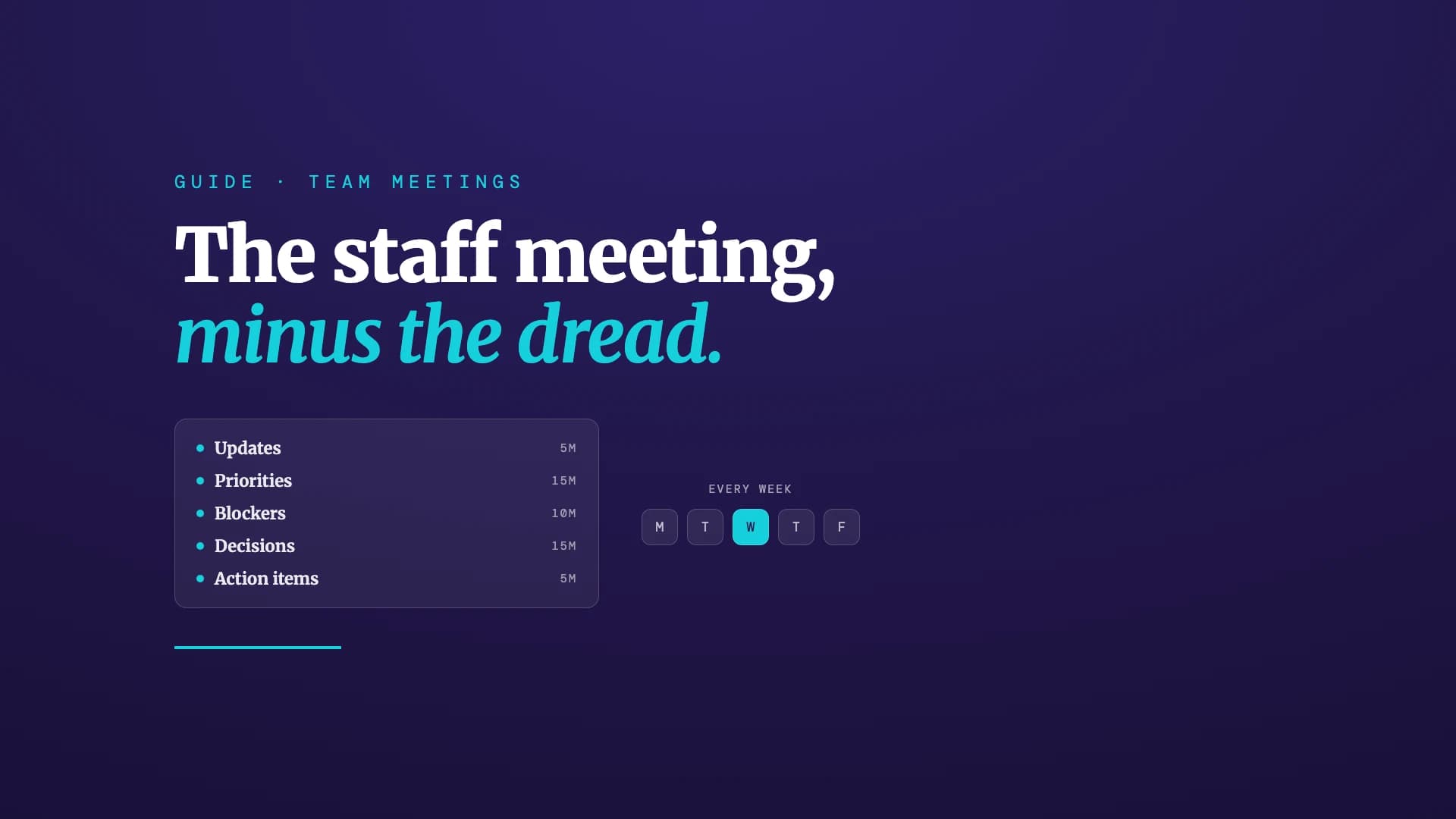
A good agenda is specific. Every item has an owner, a time box, and a clear desired outcome, and items are ranked so that if you run out of time, only the lowest-priority items roll to next week. Here is a simple, adaptable shape for a weekly 45-minute meeting:
- 5 minCheck-inA quick human moment: a win or a heads-up from each person.
- 10 minMetrics and prioritiesAre we on track? What matters most this week?
- 20 minProblems to solveThe real work: discuss and decide the few issues that need the group.
- 5 minDecisions and action itemsRestate what was decided, who owns what, by when.
- 5 minParking lotCapture off-topic items to handle later, so they do not derail.
- 45 minA weekly meeting worth attending
Two habits make this agenda work. Send it 24 to 48 hours ahead so people arrive prepared, not cold. And keep it short: a packed agenda is the enemy of a useful meeting, so some teams cap it at three real items. A small phrasing tip that genuinely helps participation: ask "what questions do you have?" instead of "any questions?"
How often? Choosing a cadence
"Meeting cadence" just means the recurring schedule a meeting runs on: how often, when, and how long. Most teams default to weekly, but the right interval depends on the work.
| Cadence | Best for |
|---|---|
| Weekly | Active projects, regular coordination, planning the week ahead. The default for most operational teams. |
| Biweekly | More independent work that needs touchpoints but also protected deep-work time. |
| Monthly | Autonomous teams, or bigger-picture review over a longer horizon. |
To choose, start from the purpose (coordination needs more frequency, strategy needs less), align the cadence to your work cycles, and then ask the team rather than assuming. Revisit it: a cadence that fit six months ago may be wrong now.
Why staff meetings go wrong
The research on meetings is not flattering. Harvard Business Review's work on the subject reports that a large majority of senior managers consider meetings unproductive, and that executives now spend roughly 23 hours a week in them, up from under 10 in the 1960s. The common failure modes are predictable: vague or overstuffed agendas, conversations that wander, attendees who do not know why they are there, and notes nobody acts on.
The single biggest one is running the meeting as a status read-out. Going person by person while everyone recites what they did is a poor use of synchronous time, because status can be read asynchronously in a doc or a project tool. A useful test: if a meeting does not end in a decision, an escalation, or a cleared blocker, it could have been a message. Reserve the live hour for the things that genuinely need the group.
Make every item end in action
A staff meeting earns its place when discussion turns into commitments that actually get done. That requires discipline about action items:
Give every action item a single named owner. "The marketing team will" is where accountability goes to die; "Sarah will" is where it lives. Pair each owner with a specific deadline, not "soon," and a clear definition of done. Capture items as they come up, not in a scramble at the end. Close the meeting by restating each action item, owner, and date out loud to confirm everyone agrees. And open the next meeting by reviewing those items, carrying forward anything unfinished so nothing quietly drops.
That last loop, reviewing last week's commitments at the start of this week's meeting, is what turns a staff meeting from a talking shop into an accountability engine.
Turn the meeting into follow-through
The hardest part of the action-item discipline above is the admin: someone has to capture every decision and commitment accurately, in real time, while also taking part. That is exactly the work worth automating. A tool like Neural Summary records the meeting and produces the summary, the decisions, and the action items with owners for you, so the facilitator can focus on running the room instead of typing, and the follow-up is ready the moment the meeting ends. The point of the meeting was never the notes; it was the follow-through.
The bottom line
A staff meeting is for alignment and decisions, not status reports. Use a short, ranked agenda with owners and time boxes, sent ahead of time. Pick a cadence that matches the work, and revisit it. Cut the status read-out and reserve the live time for problems that need the group. And make every item end in an owner, a date, and a definition of done, then review those commitments next week. Do that, and the meeting stops being something people endure.
Frequently asked questions
What should a staff meeting agenda include?
A short, ranked list of items, each with an owner, a time box, and a clear desired outcome: a brief check-in, a look at metrics and priorities, time to solve the few problems that need the group, an explicit decisions-and-action-items segment, and a parking lot for off-topic items. Send it 24 to 48 hours ahead.
How long should a staff meeting be?
Most teams do well with 30 to 45 minutes weekly. Length matters less than discipline: time-box each agenda item, protect the problem-solving block, and end on time. If you regularly finish early, that is a feature, not a failure.
How often should you hold staff meetings?
Weekly is the default for teams doing active, coordinated work. Biweekly suits more independent teams that still need touchpoints, and monthly suits autonomous teams or longer-horizon reviews. Match the cadence to the work and ask the team.
What is the difference between a staff meeting and a one-on-one?
A staff meeting is the whole team aligning and solving problems together. A one-on-one is a private conversation between a manager and one person about their development, feedback, and individual blockers. If a topic affects only one person, handle it in a one-on-one.
How do you keep a staff meeting from being a waste of time?
Cut status updates (move them to a doc), use a short ranked agenda sent in advance, time-box each item, and make sure every discussion ends in a decision or an action item with an owner and a date. Review last week's commitments at the start of each meeting so nothing slips.